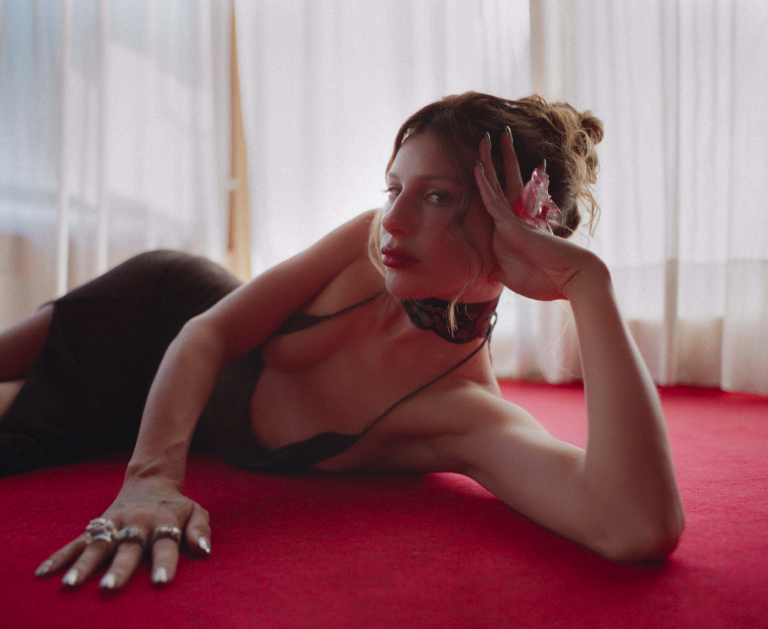
Qendresa
Qendresa
The eldest and only daughter of three children, Qendresa was born and raised in Queen’s Park,
London. She struggles to comprehend how her family made it through those early, tumultuous
days when her home country Kosovo was occupied by Serbia. “My parents fled the occupation
in ‘89, and I was born in 1990,” she explains. “I still don’t understand how they did it; how they
came to the country with no English and immediately went into work. Apparently, my mum was
doing cleaning jobs and I was just there playing or watching TV while she was working.”
Qendresa remembers hearing her father listening to artists like Sade and Lisa Stansfield, while
she explored Eminem, Dido, and the Spice Girls independently. It was her discovery of Mariah
Carey that had the greatest impact; the melismatic vocalist’s careful runs, unmatched whistle
register, and award-winning songwriting spoke to a young Qendresa, who began exploring
music in earnest in 2015 with the English trip-hop/electronica duo Zero 7. “That was through a
friend’s mum, who knew them, who grew up with them, but I also used to listen to their music as
well,” she explains. “So it was really quite a serendipitous thing.”
Qendresa’s expressive London R&B is as personality-driven as it is a natural groove. According
to the artist, her environment significantly impacted the music she makes today. “By having
multiple sounds coming from London, like grime, it was always a subconscious little push that I
probably didn’t realize,” she reflects. “But as I look back now, I realize it shaped my music a lot.”
The Kosovan artist also points to her heritage as a major source of influence and development.
“There’s this thing about London, being an ethnic minority, where you feel like you’re not going
to be perceived,” she shares. “People aren’t going to get you because no one really knows
about the subcultures and cultures of London, unless they do their research. That’s why I think
it’s important because now it’s like actually, out of necessity, I’m gonna talk about who I am.”
While working with Zero 7 was a great learning experience, Qendresa finally discovered her
voice when she began creating her own music around age 21. During these collaborative
sessions, she found herself inspired by neo-soul purists like Erykah Badu, and left-of-center
hip-hop artists like Outkast, J Dilla, The Roots, A Tribe Called Quest, and MF DOOM — artists
whose emotional depth and sonic individuality helped shape her approach. That absorption of
creativity hasn’t gone unnoticed: the Canadian rap behemoth and trendsetter Drake shared
Qendresa’s song “Tearz” on his Instagram Story, on top of posting a picture of both the Midnight
Request Line and Londra vinyls. That hat-tip turned into a DM, which turned into a co-sign.
With her new, self-produced singles, Qendresa is preparing to share an evolved edition of her
main character’s story. “Rain in July” both twinkles and pulsates, as she intimates her desires
and fears to her partner: “I don’t wanna be just a memory to you,” she repeats in a lilting tone,
attempting to control her own fate. “I really thought about Burna Boy when I was making ‘Rain in
July,’” she reveals, pointing to Afroswing as a source of inspiration. The swirling, percussive “Be
the One” sees Qendresa pitching her aching vocals up as she digs her heels in even deeper
with her lover: “Can you take me back? / I just want to rewind.”
The animated music video for the double singles is illustrated and directed by multidisciplinary
artist Sofire, who created the artwork for Midnight Request Line. In the visuals, we see our
familiar female protagonist taking agency and engaging in self-care (smoking, bathing, and
driving), as Qendresa croons for simpler times in the background.
Qendresa’s objective at the beginning of her creative journey was to do something that she
loved that would get her parents off her back; her goal has understandably shifted since then. “I
just want to enjoy my life,” she says matter-of-factly. “I don’t want to struggle. I don’t want to
suffer. I want to enjoy my life doing what I love. Obviously, life has always got suffering in it and
joy, and balance. But as I get older and I grow, it changes, because now I feel like I have a
responsibility to change the narrative of my bloodline, if you will. There was a time when the
aunties were telling me to get married at 20. There was a time when they were telling me I was
on the shelf at 23. I just don’t think that was my story. I think my story is to change the trajectory
of where my bloodline’s going
Featured Video
Popular Music